How Menopause Affects Cholesterol Levels and What You Can Do About It
Estimated Reading Time: 5.5 minutes
Menopause is a pivotal change in a woman's life, bringing a cascade of physical and emotional shifts that many women navigate in their 40s and beyond. As hormone levels fluctuate during perimenopause and menopause, one often overlooked aspect is how this transition affects cholesterol levels - many Australian women are unaware that it can alter lipid profiles, increase visceral fat and raise cardiovascular risk if left unmanaged
. High cholesterol in midlife is not just a “general lifestyle” problem; it usually reflects a specific mix of causes that differ from men, driven by hormonal change, female-specific health history, genetics and lifestyle rather than any single factor.
In this article, the focus is on how menopause impacts cholesterol and what women can do about it, with practical strategies to help navigate these changes and protect long-term heart health. Empowering women with clear, evidence-informed information makes it easier to take proactive steps such as targeting visceral fat and LDL/VLDL, to safeguard heart health during this transformative stage of life.
Why Cholesterol rises in midlife women
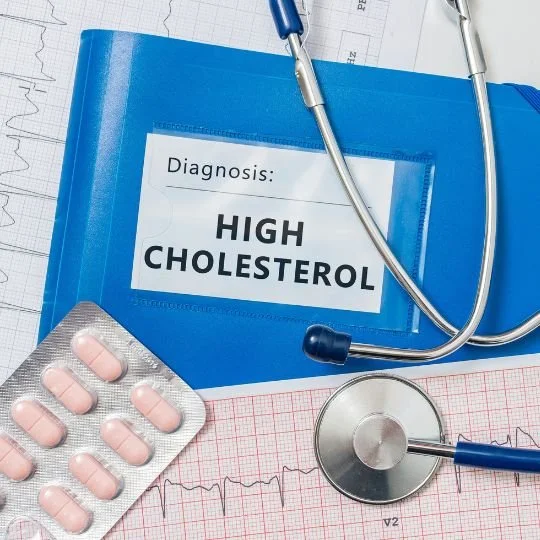
In this context, cholesterol is partly a marker of the menopause transition itself, not just a result of lifestyle behaviours.
For many women, cholesterol starts to climb around perimenopause because falling oestrogen changes how the body handles fats and where fat is stored.
Oestrogen loss is a factor contributing to:
higher LDL cholesterol (often called the ‘bad’ cholesterol’),
lower or unchanged HDL (the ‘good’ cholesterol’), and
a shift of fat from hips and thighs towards the abdomen, even when diet and exercise have not changed much.
In this context, cholesterol is partly a marker of the menopause transition itself, not just a result of lifestyle behaviours.
On top of hormones, there are female-specific “risk enhancers” that play a role.
A history of conditions such as gestational diabetes, pre-eclampsia, premature menopause or polycystic ovary syndrome can leave a long-term imprint on metabolism, predisposing to higher LDL, higher triglycerides and more visceral fat in midlife.
Genetics (for example, familial hypercholesterolaemia) can further drive LDL up independently of lifestyle, meaning some women enter midlife with decades of exposure to high LDL.
Lifestyle then adds another important layer. An unhealthy diet high in saturated and trans fats, excess alcohol, smoking, physical inactivity and gradual weight gain, particularly around the abdomen, can all push cholesterol higher and worsen the effects of hormonal and genetic factors. This means that while women cannot change their age, genes or reproductive history, targeted lifestyle changes remain a powerful way to improve cholesterol and reduce risk.
Visceral fat, LDL, VLDL and heart disease
Not all body fat behaves the same way. Visceral fat is the fat that sits deep inside the abdomen, around organs like the liver and intestines, and it is much more “active” than the fat just under the skin.
This visceral fat releases fatty acids and inflammatory chemicals straight to the liver, which encourages the liver to produce more VLDL (a “delivery” particle for triglycerides) and creates smaller, denser LDL particles that are more damaging to artery walls.
For women, the shift after menopause from carrying more fat on the hips and thighs to storing more around the waist is especially important. Even if your body weight doesn’t change much, an expanding waistline often signals rising visceral fat and a more harmful cholesterol pattern, including higher triglycerides and VLDL.
In many midlife women, this sequence looks like:
hormonal change → more visceral fat → more VLDL and “sticky” LDL → higher risk of plaque and cardiovascular events such as heart attacks and strokes.
Because of this, two women with the same BMI can have very different risk profiles depending on how much visceral fat they carry. A woman with a relatively normal BMI but a growing waistline may face a more harmful pattern (visceral fat → VLDL/LDL changes → arterial damage) than a woman whose fat is mainly under the skin, which is why waist size and body shape are key checks in midlife, not just BMI.
In addition, cholesterol and blood pressure share common drivers including visceral fat, insulin resistance, inflammation and arterial stiffness, so it is common for both to rise together in midlife women, compounding cardiovascular risk rather than acting as isolated issues.

Focusing on vegetables, fruits, whole grains, beans, lentils, nuts, seeds, extra-virgin olive oil, and fish supports healthier cholesterol and lowers overall risk.
Everyday Lifestyle Steps that Help
Understanding what is driving an individual woman’s high cholesterol helps to refine lifestyle advice beyond generic “eat better and move more”.
Helpful approaches include:
Eating in a heart-healthy way
Focusing on vegetables, fruits, whole grains, beans, lentils, nuts, seeds, extra-virgin olive oil, and fish supports healthier cholesterol and lowers overall risk. Cutting back on processed foods, takeaways, pastries, fatty meats, and foods with palm or coconut oil reduces saturated and trans fats, while plant sterols/stanols (in some margarines and yoghurts) can give an extra push to bring LDL down.
Moving more, sitting less
Regular movement helps raise HDL (“good”) cholesterol, lower triglycerides and reduce visceral fat. Aiming for steady moderate activity such as brisk walking, cycling or swimming on most days, plus two sessions of strength or resistance training each week, improves insulin sensitivity and gradually shifts the blood fat profile into a safer range.
Focusing on the waist, not just the scales
Even modest weight loss, particularly from around the middle, can improve LDL, VLDL and triglycerides, as well as blood pressure and blood sugar. Good sleep, stress management and consistent routines make it easier to maintain these changes over time, even if the total kilograms lost are small.
Smoking and alcohol
Quitting smoking improves circulation and reduces the chance of plaque forming in the arteries, while also supporting healthier HDL levels. Keeping alcohol to recommended limits (as low as possible) helps prevent high triglycerides and VLDL, which often rise with both drinking and visceral fat.
Medications that target LDL and VLDL
Sometimes lifestyle changes are not enough on their own, especially when cholesterol is very high or when overall heart risk is raised by factors such as early menopause, strong family history, high blood pressure or diabetes. In these cases, medication is added to lifestyle measures rather than replacing them.
The main medicines used to lower LDL are statins, which work in the liver to reduce cholesterol production and pull more LDL out of the bloodstream.
If LDL is still above the agreed target, ezetimibe may be added, and in women with very high risk or inherited cholesterol problems, newer medicines such as PCSK9 inhibitors may be considered.
When triglycerides and VLDL are particularly high, doctors may also use fibrates or prescription omega-3 products alongside statins, especially if there are other risks like diabetes or a history of heart disease.

Hormone replacement therapy (HRT) can influence cholesterol levels, but it is not used primarily as a cholesterol treatment.
Can HRT Affect Cholesterol Levels?
Hormone replacement therapy (HRT) can influence cholesterol levels, but it is not used primarily as a cholesterol treatment. Oestrogen-containing HRT tends to lower LDL (“bad”) cholesterol and can raise HDL (“good”) cholesterol in many postmenopausal women, with some regimens also affecting other atherogenic particles, although triglyceride responses vary.
Despite these potential lipid benefits, HRT is not recommended as first-line therapy for high cholesterol or for preventing heart disease; decisions about HRT are mainly based on menopausal symptom relief, bone health and an individual’s cancer and clotting risks, with cholesterol changes viewed as a secondary benefit.
For a midlife woman with high cholesterol, HRT may modestly improve her lipid profile if she is already a suitable candidate for menopausal hormone therapy, but LDL and VLDL are still best managed through targeted lifestyle changes and, when indicated, dedicated cholesterol-lowering medications rather than HRT alone.
What A Causality-Based Approach Looks Like in Practice
A causality-based approach focuses on why a woman’s cholesterol is high, so that treatment targets the real drivers rather than just the lab number. For a midlife woman, useful questions include:
How much of her cholesterol rise is linked to menopause and visceral fat redistribution?
Are there reproductive or genetic factors that have pushed risk higher for years?
How much is due to current lifestyle (diet, movement, smoking, alcohol)?
The treatment plan then matches this causal picture: targeted lifestyle strategies to reduce visceral fat and improve the lipid pattern, combined with medications when the underlying drivers and overall risk suggest that lifestyle alone will not be enough.
This approach respects the distinct biology of midlife women and makes it more likely that LDL and VLDL are lowered in a way that meaningfully reduces heart disease risk, rather than simply ‘chasing a number’ on a lab report.
Because women often underestimate their chance of heart disease, it is worth taking changes in cholesterol and waist size seriously in the 40s, 50s and 60s, even if there are no symptoms. With steady lifestyle changes and, when needed, the right medicines, most midlife women can significantly lower their cholesterol, reduce visceral fat and cut their risk of heart attack and stroke in later life.
References
Atherosclerosis Australia (Aust). (2017) ‘Cholesterol and cardiovascular disease’. Available at: https://www.athero.org.au/fh/patients/cholesterol-and-cardiovascular-disease/ (Accessed 10 December 2025).
Australian Heart Research Institute (HRI). (2024) ‘Understanding what is high cholesterol: signs & symptoms’. Available at: https://www.hri.org.au/health/learn/risk-factors/high-cholesterol (Accessed 10 December 2025).
Healthdirect Australia. (2024) ‘Cholesterol: what to do if your cholesterol is too high’. Available at: https://www.healthdirect.gov.au/cholesterol (Accessed 10 December 2025).
Jean Hailes for Women’s Health. (2025) ‘Cholesterol – fact versus fiction’. Available at: https://www.jeanhailes.org.au/news/cholesterol-fact-versus-fiction (Accessed 10 December 2025).
Mach, F., Baigent, C., Catapano, A.L. et al. (2025) ‘Guidelines for the management of high blood cholesterol’, in Feingold, K.R., Anawalt, B., Boyce, A. et al. (eds) Endotext. South Dartmouth, MA: MDText.com, Inc. Available at: https://www.ncbi.nlm.nih.gov/books/NBK305897/ (Accessed 10 December 2025).
Mancini, G.B.J., Hegele, R.A., Leiter, L.A. et al. (2022) ‘Evaluation and management of blood lipids through a cardiovascular risk reduction lens’, Canadian Journal of Cardiology, 38(3), pp. 338–351. Available at: https://pmc.ncbi.nlm.nih.gov/articles/PMC8956895/ (Accessed 10 December 2025).
Mauvais-Jarvis, F., Manson, J.E., Stevenson, J.C. and Fonseca, V.A. (2019) ‘Gender differences in lipid profile and therapy’, Revista Portuguesa de Cardiologia, 38(4), pp. 275–283. Available at: https://www.revportcardiol.org/en-gender-differences-in-lipid-profile-articulo-S2174204919302429 (Accessed 10 December 2025).
National Cholesterol Education Program (NCEP). (2002) ‘Cholesterol treatment guidelines update’, American Family Physician, 65(5), pp. 871–880. Available at: https://www.aafp.org/pubs/afp/issues/2002/0301/p871.html (Accessed 10 December 2025).
Neeland, I.J., Poirier, P. and Després, J.P. (2023) ‘Visceral adipose tissue and residual cardiovascular risk’, European Heart Journal Supplements, 25(Suppl. B), pp. B92–B101. Available at: https://pmc.ncbi.nlm.nih.gov/articles/PMC10421666/ (Accessed 10 December 2025).
Okamoto, T., Kato, M., Yamada, S. et al. (2025) ‘Exploring the link between visceral fat and cardiovascular risk in women’, Journal of Cardiometabolic Risk, 15(4), pp. 210–222. Available at: https://pmc.ncbi.nlm.nih.gov/articles/PMC12527845/ (Accessed 10 December 2025).
More Posts on Menopause